Sweden’s forestry model combines productivity with strong environmental responsibility. It is based on long-term practices that ensures that future generations can enjoy and use at least as much forest as we do today.
Even aged retention forestry follows a recurring cycle in which the forest is regenerated, managed and then harvested. Each stage plays an important role in creating a stable and productive forest over time. Here, we explain what the process looks like in practice.
Planting
Planting is a reliable and well‑established way of establishing new forest, giving forest owners the opportunity to choose tree species. It is also important to select species based on site conditions. Spruce thrives on more moist soils than pine, which is why spruce is planted in low‑lying areas, while pine is planted on higher ground.
One advantage of planting is the ability to use improved planting material with desirable characteristics. In the context of climate change, resistance to drought is an example of valuable genetic traits that are prioritised in tree breeding. Today’s improved seedlings grow up to 25 per cent faster than unimproved ones, increasing both forest growth and its contribution to climate benefits.
Natural regeneration
In addition to planting, natural regeneration also takes place from trees that are left standing on the harvested area and that shed seeds over several years. The species regenerating naturally include pine and spruce, as well as a substantial proportion of broadleaved trees, contributing to overall diversity. Over time, these seed trees can be removed to make room for young trees. Some large trees, known as retention trees, are often left permanently. Trees retained along the edges of a clear‑cut area and in surrounding forest – known as a shelterwood – also contribute to natural seeding.
Seed trees naturally suppress grass growth, resulting in many seedlings becoming established in the same area. This helps spread browsing pressure from deer, roe deer and moose across more young trees.
Natural regeneration can also be supplemented with improved seeds that are sown manually or by a site‑preparation machine.
Pre-commercial thinning and thinning
Just as a gardener thins seedlings in a vegetable plot, forest owners thin their forests to create favourable conditions for selected trees. This results in better timber quality and reduces the risk of damage from storms and snow.
Pre-commercial thinning
Young trees need space to develop into large and valuable trees. Since forests at this stage consist of both planted and naturally regenerated trees, it is often possible to shape the future forest with the mix of tree species best suited to the site. This creates variation and diversity. The remaining trees are of good quality and evenly distributed across the area.
During pre-commercial thinning, the trees are too small to be used industrially. The felled trees are left on the ground to decompose over time, becoming nutrients for other plants and trees.
Thinning
To maintain good growing conditions, the forest is thinned one or more times. As with pre-commercial thinning, the aim is to retain high‑quality trees that can continue to grow and eventually become valuable timber.
At the first thinning, the forest is usually 30 – 40 years old. One or more additional thinnings are often carried out before final harvesting. The age at which thinning takes place and the number of thinning operations vary between southern and northern Sweden.
Time to harvest – final felling
When the trees have reached maturity, it is time for final harvesting. Coniferous trees may be harvested at 45–100 years of age, beech at around 80 years, and oak at around 90 years. In practice, trees are usually harvested at a considerably higher age than required by law. The average age at final felling is approximately 100 years. Before harvesting, inventories of natural and cultural values are carried out and careful planning is done.
Modern technology such as satellite imagery, drones, AI‑based image analysis and digital map data – including comprehensive height models of tree layers and terrain – now facilitates this work.
Harvesting with retention
During harvesting, trees are felled, cut into logs and sorted. Depending on species, quality and dimensions, the timber is used for different purposes. Not all trees are harvested. Parts of an area may be left untouched, for example to preserve the feeling of a mature forest near urban areas or recreational sites where people enjoy spending time. By leaving a small stand of trees, buffer zones along watercourses, retaining old and dead trees, or clearing around overgrown historic foundations, conditions are created for biodiversity and cultural values are protected.
After harvesting, the land is prepared to create the best possible conditions for a new generation of trees. Planting and seeding then begin, and a new cycle starts.
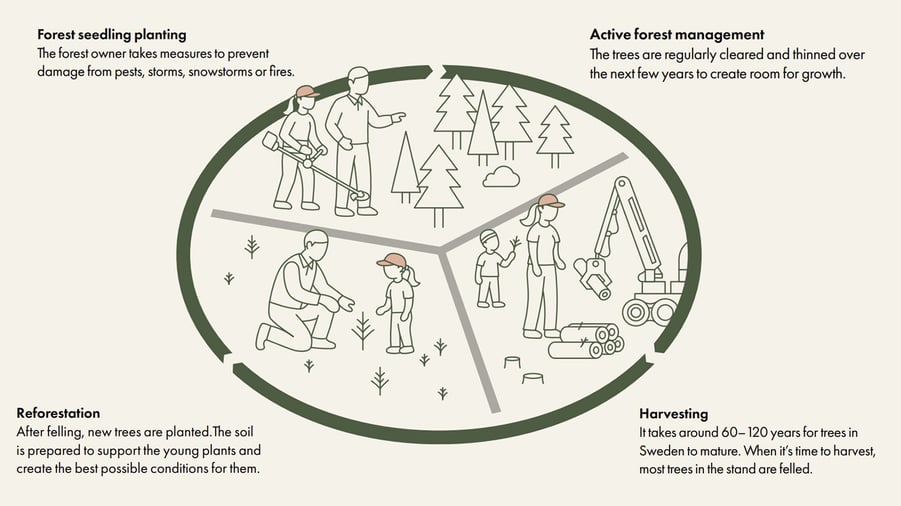
The Swedish forestry model – based on a recurring cycle in which the forest is regenerated, managed and then harvested.